

 Meine Favoriten
 Abmelden
 Registrieren
 Weltwoche Deutschland


 Anhören ( 12 min )
 In early August I travelled from Berlin south into central Germany. Along the way, I had a few unexpected conversations that gave me some insight into the growing support for the Alternative für Deutschland (AfD) and that complicate the dominant narrative about right-wing extremism. The AfD is currently polling around 30% nationally and 42% in the state of Sachsen-Anhalt, where I was traveling. It is likely to emerge victorious in the September 6 state elections.
mauritius images / Andreas Vitting
This strength of the AfD is viewed with considerable anxiety by the ruling coalition in Berlin, made up of the Christian Democrats and the Social Democrats, who have declared it an extremist threat to democracy. If that is true, how could anyone support it? The encounters I had with a random set of Sachsen-Anhalt residents left me with a more differentiated picture. I learned something about why some Germans are drawn to the AfD. Of course, my few conversations can hardly be considered a representative survey. But close listening to people who are willing to talk cannot be bad.
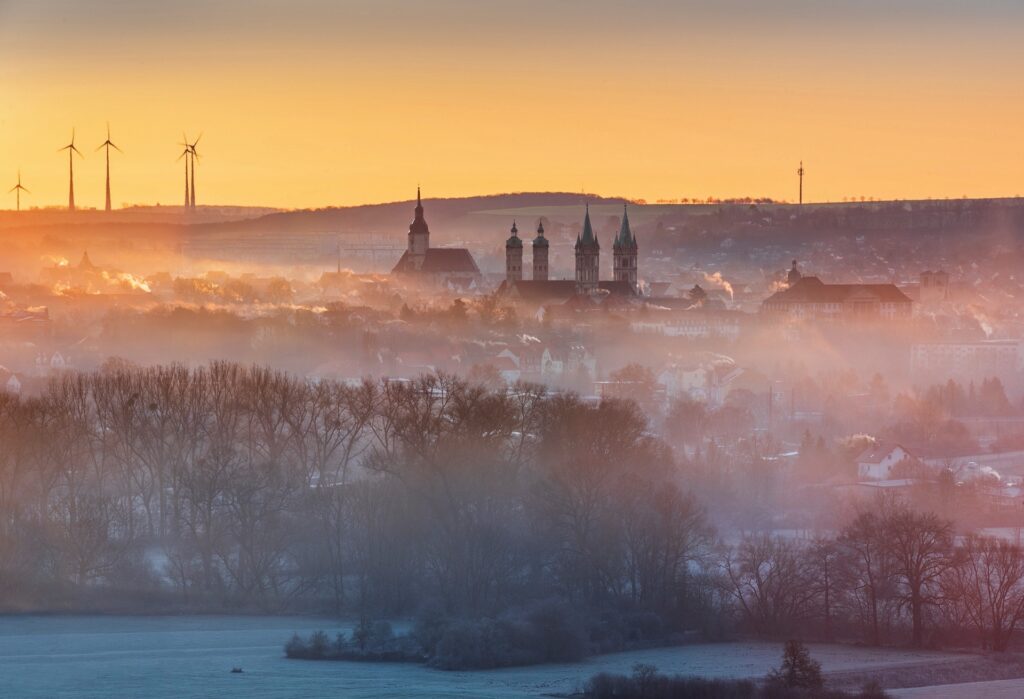
My trip took me through smaller cities and towns in Sachsen-Anhalt—Naumburg, Quedlinburg, Halberstadt, and Gernrode, very provincial Germany. As a listening tour, it gave me the opportunity to take the political pulse on the eve of the election. I tried to get a sense of what people are thinking and what draws them to the AfD, despite the hostility it faces. To jump to the chase: my interlocutors all shared a diffuse sense that something is going wrong in Germany, and they see the AfD as offering a chance to improve the situation.
Nonetheless, I did not hear much direct enthusiasm about the AfD. Instead, there appears to be a willingness to give the AfD a chance because it is seen as a plausible alternative to the established parties. Those parties are judged as having failed to address the sources of national distress. In other words, at least part of AfD support is primarily an expression of disappointment with mainstream parties, rather than a full-throated endorsement of the AfD.
I also heard no particular excitement about individual AfD politicians as leaders: no personality cult. Whatever critics of the AfD mean by calling it fascist, I saw no adulation of a charismatic leader, no Duce or Führer. Since the AfD so far has been shut out of any positions of responsibility, its party leaders have never been tested with governing authority. On the one hand, this exclusion has prevented them from having real power, but on the other, they have never had to show whether they have the skill and intelligence to govern.
Before continuing with the AfD supporters, I offer a quick prelude concerning the mood in Germany today. When my express train from Berlin was suddenly cancelled and I had to make do with a later connection, I found myself seated beside a regular train passenger who volunteered the comment that such disruptions in the German train system have become common. Deutsche Bahn, so she reported, just seems unable to manage matters well. As we were ironically agreeing that the Italian train system displays greater efficiency, matters took a turn for the worse, at least for some travellers. An announcement suddenly came through that the train would skip the planned stop at Erfurt—no negligible place, but the capital of Thuringia—and that passengers headed there would have to get off earlier and make other arrangements. In retrospect, the disruptions in the train schedule anticipated what I would hear later from AfD supporters who repeatedly insisted that the country is just not being managed well.
In a few encounters with Sachsen-Anhalters, I found opportunities to steer the discussion to the September election and asked about their thoughts and concerns. All confirmed that an AfD wave is on the way, although opinions were split as to whether it would suffice for an absolute majority. Some of my informants outed themselves explicitly as AfD supporters without hesitation. Another expressed sympathy for the AfD but declared that he would not be voting at all: he does not trust any elections because he believes that there is too much fraud and, in any case, no party—including the AfD—will ever deliver on what it promises. One further interlocutor hesitated to declare his own party allegiance, although he insisted that “something has to change,” and he is certain that “the other parties” will not do anything.
My conversation partners either intend to vote for the AfD or expressed a degree of support for the prospect that the AfD will win. However, their comments suggest to me that they are not AfD “fans,” passionate adherents. On the contrary, they have turned to the AfD, in varying degrees, because of their disaffection from the other parties or from the political system in general. The AfD is winning by default.
The AfD initially emerged as a voice of Euroskepticism, with doubts about the common currency and the budgeting that would come with it, but it was soon taken over by national conservatives, for whom lax immigration policy became the primary plank in their platform. Standard narratives of the party’s history begin with this shift from an economic paradigm to a demographic one. Yet there is an underlying continuity linking those two steps: the move from an initial German national anxiety about the primacy of the EU over national sovereignty to a second stage of German national concern over what is perceived as excessive immigration. Remarkably, most of my informants did not mention concerns about immigrants at all until I prompted them. Only one volunteered “refugee policy” as a key driver for his AfD support. The occasional complaints about crime might have carried an implication concerning immigration, although when crime was mentioned it was described as something taking place elsewhere, in big cities, not something characteristic of small-town Sachsen-Anhalt. In any case, they did not sound like the racists I had been led to expect.
A skeptic might reply that my conversation partners hid their anti-foreigner sentiment because they were speaking with me, a foreigner, albeit a German-speaking one. Perhaps, but I walked away from those conversations without the impression of AfD supporters exuding xenophobia. Instead there were plenty of other points that they brought forward as grounds for their AfD support. First and foremost were repeated complaints about a lack of jobs: it’s the economy, stupid. I heard a concern that the region had been developed primarily toward tourism, meaning that certain kinds of trades were disappearing in a perceived shift toward a service sector economy.. The argument about the prioritization of tourism included some regret as to how the region has changed since unification, and it may also reflect a response to a global transformation in the nature of labor. Even while bemoaning the lack of employment opportunities, one of the informants, an older one, also insisted that too many young people just do not want to work because they can live off state dole. There is obviously some tension between these two complaints—not enough jobs and people who don’t want to work—but they can combine to fuel a broad anger about the status quo. The paradox of the simultaneity of these quite different arguments points to the thesis that people are reacting to an underlying economic shift that they feel is passing them by. This sense of being disregarded may be the key to their AfD sentiment.
Add to that political-economic complex the explicit complaints about the price of gas and energy prices in general. As my interlocutors see themselves squeezed economically, they also object to government spending overseas. No one specified exactly which foreign spending they mean: perhaps they were thinking about support for Ukraine or, alternatively, some of the various ecological and cultural projects Germany has funded in developing countries. Their general conclusion is that Germany should begin to take care of its own first. One even invoked Trump’s “America First” rhetoric, calling for a similar prioritizing of German needs. If I understand them correctly, they are asking for more attention for themselves—and less for others—as a correction to their experience of systemic disregard.
Such was the voice of AfD supporters on the ground one month before the election. My main take-away was a sense of economic hurt and a perception that the federal government in Berlin ignores them. That government is also viewed as generally incompetent: nothing runs well—the same motif I had heard on the train: whatever happened to German efficiency?
The AfD supporters, regularly denounced as racist, did not mention Islam or terrorism, despite the very recent car attack by an Islamist on the Christopher Street Day parade in Berlin. There was no explicit reference to foreign policy—Ukraine, Russia, Iran—except indirectly as an implication of the critique of foreign expenditures. Nor was there any mention of Jews or globalists or conspiracy theories, even though the AfD is regularly described as neo-Nazi and antisemitic.
The expressions of disaffection may be an after-effect of unification since this former East German region is seen as being disadvantaged because it is eastern. The AfD has also had success in western Germany, but by no means as much as in Sachsen-Anhalt. I do not believe that I was hearing classic “Ostalgie” in the sense of a longing for the GDR. In fact, I heard no reminiscences of the Communist past at all. The topic just did not come up.
What I heard, rather, was an echo of 1989—not nostalgia for the GDR, but nostalgia for the moment when ordinary East Germans believed that Wir sind das Volk could force an unresponsive political order to listen, the spirit of the peaceful revolution. The speakers basically explained the widespread AfD support as a matter of Wir sind das Volk—we are the people—the slogan of the anti-Communist demonstrations that forced the end of the GDR regime. During the decades of the GDR, the government had consistently ignored the people. Now they see the new regime, the “Berlin Republic,” as similarly ignoring them. Obviously, this conjecture would have little applicability in the West, but it could explain a defining undercurrent in the East. At least this trope resonated in the remarks I heard: the government of the established parties is ignoring the people, and an alternative is needed.
The accusation that the government is engaged in a systematic ignoring of popular demands can be corroborated. The governing parties have maintained a Brandmauer, a firewall, against the AfD, refusing any political cooperation. I saw this in action in an unexpected way. On my last night in Naumburg, I wandered into the market square, which was alive with food vendors and wine-tasting, a real street festival. In one corner, the AfD had set up shop with a stand, giving away AfD-themed swag along with political brochures. The local AfD candidate was there taking questions: retail politics. Yet no other party was present, even in this last stretch before the election. That absence at an event so obviously rife for campaigning is striking. Whatever the practical reason for their absence, the scene offered a visual image of the political firewall: the AfD alone was courting voters whom the established parties seemed to have conceded. One can speculate that for the CDU or the SPD, even speaking in that environment would run the risk of breaking the firewall because they would likely have to engage with AfD supporters. The suspicion directed against the AfD, the party, may also mean a general suspicion of AfD voters as well. We need to understand that suspicion better.
A prominent feature of populism is anti-elitism. I heard plenty of that in the form of mistrust of politicians. The AfD supporters expressed hostility toward “the top.” Yet within any political field marked by populism, the elite responds with a symmetrical hostility. Instead of mounting rational counterarguments, it treats the populist electorate with contempt, viewing it as, to use Hillary Clinton’s term, “deplorable.” Her language contributed to her defeat because it marked her as indelibly elitist, looking down at the mob. There has been a German corollary involving a similar rhetorical mishap. Baerbel Bas, co-chair of the Social Democratic Party and currently Minister of Labor and Social Affairs, delivered an address on May 21, explaining why Germany needs diversity, i.e., immigration. There are, of course, plausible arguments, beginning with the need to grow the labor force in a country with a shrinking population. It was, however, a different argument that revealed an ugly side of how Germany’s political leadership views the people. According to Bas, Germany needs immigration because without diversity, Germany would become uniformly “brown.” In standard German political color coding, brown means Nazi, versus black as the clerical color for the Christian Democrats or red, the traditional color of the labor movement, for the Social Democrats. Whatever Bas intended, the formulation can easily be heard as implying that, absent demographic diversification, Germans are liable to revert to their “brown” past.
Bas’s judgment provides a perfect bookend to my encounters with AfD supporters. Despite standard expectations, they never launched into racist attacks on foreigners. Instead, they couched their grievances in the expectation that the government should take better care of the people’s needs because—Wir sind das Volk—we are the people for whom the government should work. Meanwhile, the import of Bas’s comment is that the voice of the Volk may be being heard as völkisch, rooted in ethnonationalism. Yet if the German political leadership recoils in this way from a fundamental claim of popular sovereignty—the “we the people” moment of modern democratic politics—then German democracy faces a problem larger than the rise of the AfD itself.
My conversations suggest that it is important to distinguish among three different discourses. First, there is what AfD spokespersons, the party leadership, and its platform say, which I would broadly characterize as national conservative. Second, there is the discourse of the AfD’s political opponents, who unambiguously denounce the party as Nazi, fascist, racist, and an outright threat to democracy. The clash between these two discourses dominates the public sphere in a zero-sum game.
But there is a third discourse as well: the voices of the people who may actually cast their votes for the AfD. Their motivations should not simply be identified either with the pronouncements of party leaders or with the accusations of the party’s critics. My few encounters certainly cannot tell us what all AfD voters think. They do, however, suggest why it matters to listen to them before deciding that we already know. The political debate will remain incomplete as long as the AfD voter is treated merely as an extension of the AfD—or dismissed in advance as “brown.”
Russell A. Berman is Walter A. Haas Professor of the Humanities at Standford University and Senior Fellow at the Hoover Institution.