

 Meine Favoriten
 Abmelden
 Registrieren
 Weltwoche Deutschland


 Anhören ( 12 min )
 Donald Trump is often described as a disruption. His supporters call him a corrective. His critics call him a catastrophe. Depending on whom you ask, he is either the man who rescued America from managed decline or the man who accelerated its unraveling. Yet both sides share a curious and revealing assumption: that Trump arrived from somewhere outside the American story, that he is a foreign object lodged in the national body. He is not.
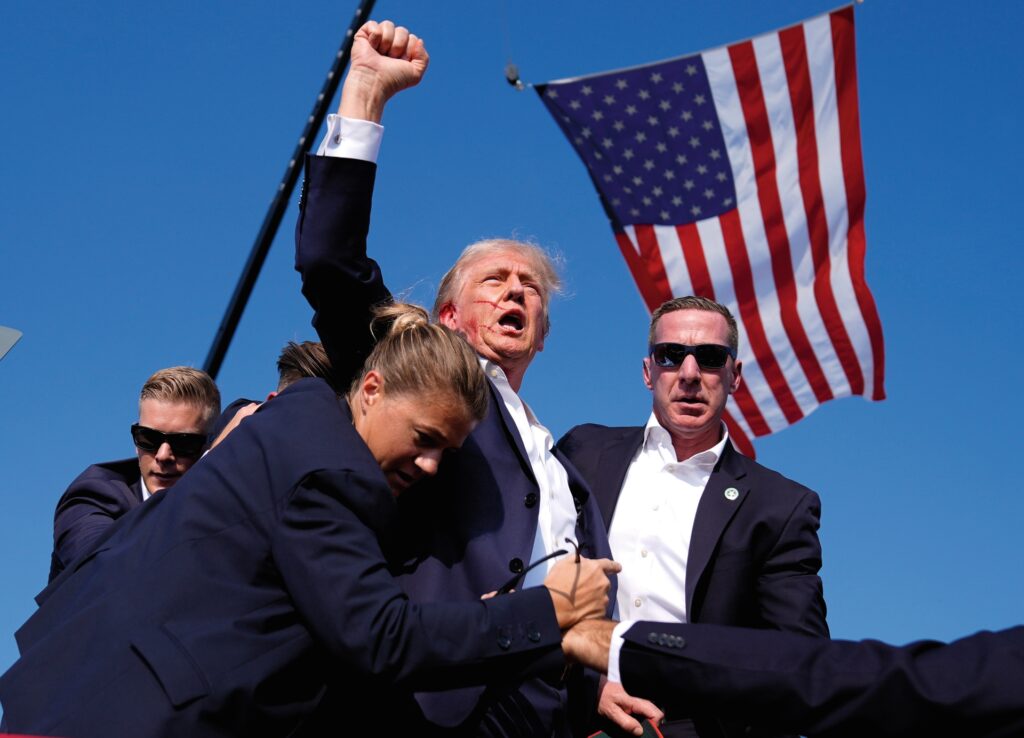
Copyright 2024 The Associated Press. All rights reserved
He sought opportunity where he could find it
Donald Trump is not an interruption of the American story. He is one of its most recognizable chapters - brash, contradictory, excessive, survivable, and somehow, against considerable odds, impossible to look away from. To understand him only as a politician is to fundamentally misunderstand him. Politicians emerge from systems. Trump emerged from a culture. Long before he occupied the White House, he occupied something arguably more powerful in modern America: the collective imagination.
The story, like most American stories worth telling, begins with immigration. Friedrich Trump arrived in the United States from Kallstadt, a small village in Bavaria, in the late nineteenth century. He came with little money and no advantages beyond the one that mattered most: the belief that the country he was entering did not care where you came from, only what you were willing to build. He sought opportunity where he could find it, running restaurants and lodging houses in the Klondike during the Gold Rush, accumulating property, pressing forward. He passed something on to his son. His son passed it further.
The immigrant occupies a sacred place in the American imagination. America has always been a nation built on the idea that people can begin again, that the self is not fixed by birth, class, or geography, but is infinitely malleable in the hands of someone willing to push hard enough. Friedrich Trump was the living proof of that idea. His arrival in America was not merely a biographical detail. It was the founding act of a distinctly American dynasty.
Fred Trump, Donald's father, inherited that entrepreneurial instinct and transformed it into a substantial real estate empire across Queens and Brooklyn, disciplined, careful, methodical. Housing for the middle class. Physical expressions of postwar American confidence. Donald inherited more than wealth from his father. He inherited scale. And then he discarded the carefulness entirely.
He went to Manhattan. He put his name on buildings in letters ten feet tall. He understood something fundamental about modern America before most politicians, journalists, and intellectuals had grasped it: attention had become a form of power. The brand was the building. Perception was reality. America was already moving toward a culture in which visibility mattered almost as much as achievement, and Trump moved toward that culture with the instincts of someone who had been waiting for it his whole life. This is not cynicism. It is, in fact, one of the foundational spiritual beliefs of the American republic.
Here is where serious people have consistently gotten Trump wrong. They assume the showmanship is a mask, a strategic veneer over some quieter, more calculating self. They imagine that behind the gold-leaf interiors, the rallies, the catchphrases, and the carefully maintained persona, there exists a different man who at night removes the performance like a costume. There is no such man.
Familiar figure
The performance is the man, and the man is the performance, and this too is profoundly American. America invented modern celebrity. It invented the idea that personality itself was a commodity, that charisma was capital, that the right to self-promotion was as inalienable as anything the founders enumerated. P.T. Barnum understood this. So did Muhammad Ali, Walt Disney, and every great American entertainer who turned themselves into a myth while still living inside the ordinary facts of a life.
Trump's name appeared on skyscrapers, casinos, golf courses, books, and eventually a television program watched by millions. “The Apprentice” completed the transformation. He became a national character before he became a national candidate. Millions of Americans invited him into their homes every week. They watched him project authority, reward competence, punish failure. The image was constructed, yes, but then, all public images are. The important distinction is that by the time Trump entered politics, he was not a stranger asking for trust. He was a familiar figure asking for power. That distinction matters more than most analysts acknowledged at the time.
His aesthetic, maximalist, unapologetic, aspirational in the most material sense, is not far removed from the Las Vegas Strip at midnight, the Super Bowl halftime show, or the American shopping mall in its full pre-internet glory. It is the dream of plenty made architecturally literal. You may find it garish. Millions find it magnificent. Both reactions are legitimate, and neither is stupid. This ambiguity lives at the very heart of the American experience.
Trump's critics frequently accused him of behaving more like an entertainer than a statesman. They were often right. But the criticism consistently missed the larger point. Modern politics increasingly resembles entertainment. Campaigns compete for attention. Politicians build brands. Media cycles reward conflict. The public judges leaders not merely on competence but on their ability to command interest and project narrative. Trump did not create these conditions. He mastered them, while career politicians were still pretending they didn't exist.
The 2016 election shocked observers not because Trump materialized from nowhere, but because large portions of the American establishment had catastrophically misread the country they claimed to know. Decades of economic dislocation, the hollowing of manufacturing communities, declining trust in institutions, two failed foreign wars, and an accelerating sense among millions of ordinary Americans that the people governing them held them in quiet contempt, all of it had been accumulating like pressure beneath still water. Trump arrived and named it without apology, without the hedging language of consensus politics, without the careful triangulations that had come to define professional governance.
He stood up. He raised his fist.
His appeal was never primarily ideological. It was emotional. He spoke with certainty in an age of institutional hesitation. He projected confidence in an era defined by managed doubt. He appeared willing to fight when others appeared eager to manage. He told people who felt invisible that they had been seen. Whether one admired or deplored those qualities, they resonated at a frequency that polling models and pundit consensus had entirely failed to detect.
His presidency was what the man himself has always been: turbulent, controversial, energetic, and impossible to ignore. He rewrote trade policy with the blunt instrument of tariffs, challenging decades of free-trade orthodoxy. He confronted NATO allies over defense spending with a directness that made diplomats flinch and some adversaries recalibrate. He brokered the Abraham Accords, a genuine diplomatic achievement that conventional wisdom had long declared impossible. He dismantled regulatory frameworks at a pace that thrilled his base and alarmed his opponents in equal measure. He governed not through careful institutional management but through force of personality, which meant both the achievements and the failures were outsized, because everything around him became outsized.
No recent American president inspired stronger feelings. Not merely strong disagreement, actual visceral emotion, on every side. He transformed politics into a permanent national argument, and the argument, in its intensity, revealed something important: that the fractures Trump exposed had been there long before him. He didn't create the divide. He illuminated it. In July 2024, in Butler, Pennsylvania, a bullet passed within inches of his right ear. He stood up. He raised his fist. The image, blood on his face, hand raised against the American sky, became one of the defining photographs of the twenty-first century, regardless of one's politics.
You can interpret it however you wish. But you cannot look at it and argue the man lacks some fundamental relationship with survival, with contingency, with the sense that fate has particular designs on him. This feeling, the conviction of being preserved for a purpose, is itself a deeply American spiritual posture. The American story is populated by men who were struck down and rose, by institutions that appeared finished and reformed, by cities that burned and rebuilt. But the bullet was only the most dramatic entry in a long ledger of survivals.
The early 1990s bankruptcies were catastrophic enough to have ended most careers. The banks wrote off hundreds of millions. The tabloids composed his epitaph. He came back. The Access Hollywood tape was supposed to end his first campaign. It didn't. The impeachments, the indictments, the prosecutions, the years of late-night ridicule maintained as a near-constant cultural background hum, none of it finished him. Then came the 2020 defeat, and the assumption, understandable in its logic, that the story was over. Former presidents rarely return. Political momentum historically moves forward, not backward. Trump violated that rule too.
America loves a comeback with a ferocity that borders on the religious. It believes in second acts more devoutly than any other culture on earth. F. Scott Fitzgerald famously wrote that there are no second acts in American lives, and Americans have spent the century since proving him spectacularly wrong. Trump's story is structurally almost nothing but second acts. He seems to require near-destruction the way other men require coffee, not as tragedy but as fuel. The 2024 return was not merely a political event. It was a narrative completion. The defeated man, the indicted man, the man who had been told in every conceivable register that he was finished, returning to the office he had left. Whatever you believe about what that means for the republic, as a story it is undeniably, recognizably, American.
Here is what makes Trump genuinely fascinating as a cultural object: he refuses allegorical simplicity. He will not be merely the villain. He will not be merely the hero. He is capable of unexpected personal warmth and of discarding allies with a coldness that takes the breath away. He is dishonest in ways that are almost theatrical, yet appears to believe many of the things he says with genuine conviction. He is a bully who visibly enjoys other people. He is, in short, contradictory in the way that actual human beings are contradictory, not in a literary way that reveals hidden depth, but in a human way that simply reflects what seventy-some years of experience, ambition, fear, and ego actually produces. And here is where the thesis earns its weight.
America is contradictory in precisely this way. It was founded on the proposition that all men are created equal by men who owned other men. It built the most extraordinary middle class in human history and largely watched it dissolve without intervention. It preaches freedom with genuine fervor and maintains the largest prison population of any developed nation on earth. It produces the most moving art about human loneliness and the most sophisticated machinery for manufacturing distraction from it. It is simultaneously the most idealistic country that has ever existed and one of the most pragmatically ruthless. It believes in itself with a fervor that is at once its greatest engine and its most persistent danger.
Trump holds all of these contradictions not as a philosopher holds ideas, but as a body holds its history. He is not a symbol of America. He is something stranger and more useful than a symbol. He is a specimen a concentrated distillation of the national character pressed into one outsized, impossible-to-ignore human being. You could not manufacture him elsewhere. Not in Germany, where his grandfather came from, where the culture has a deep allergy to nationalism of the self. Not in England, where class still functions as a brake on pure reinvention. Not anywhere that inherited limitation still carries authority. He is specifically, structurally, the product of this particular country's particular and radical beliefs about what a person is permitted to become.
Argument about America itself
Arguments about Trump rarely stay arguments about Trump. They become arguments about America itself, what kind of nation it is, what it values, what it is willing to tolerate, what it secretly admires, what it pretends not to admire while admiring it anyway. The debate persists at this intensity because Trump has become the surface onto which millions of Americans project their unresolved arguments with each other. That does not happen with ordinary politicians. It happens with figures who touch something foundational.
Only America could produce this specific biography: the grandson of a German immigrant who built a real estate empire, became a global entertainment brand, hosted a television program watched by millions, descended a golden escalator into presidential politics, won, lost, survived an assassination attempt, and came back to win again, all within a single lifetime, all on the same island where his father built modest homes for working families. The biography sounds improbable. But America has always sounded improbable to those watching from outside, and entirely inevitable to those living inside it.
That does not mean Trump is America in its totality. No individual could be. America contains multitudes, in its contradictions, its generosities, its violence, its beauty, its remarkable and recurring capacity for reinvention. Trump does not represent all of it. No one does. But he represents a recognizable and significant strand of it the belief that visibility becomes influence, that failure becomes opportunity, that the self is a project rather than a fixed inheritance, and that yesterday, no matter how definitively it seemed to close the book, never quite has the final word.
He is not America's exception. He is one of its most revealing expressions. And perhaps that is why the argument over Donald Trump has never really been an argument about Donald Trump at all. It has always been an argument about America itself, what it made, what it values, what it is still deciding to become.
About the Author:
David Mamet is a Pulitzer Prize–winning playwright, screenwriter, and essayist. His most recent book is The Disenlightenment: Politics, Horror, and Entertainment. He writes frequently about culture, politics, and the language of power.