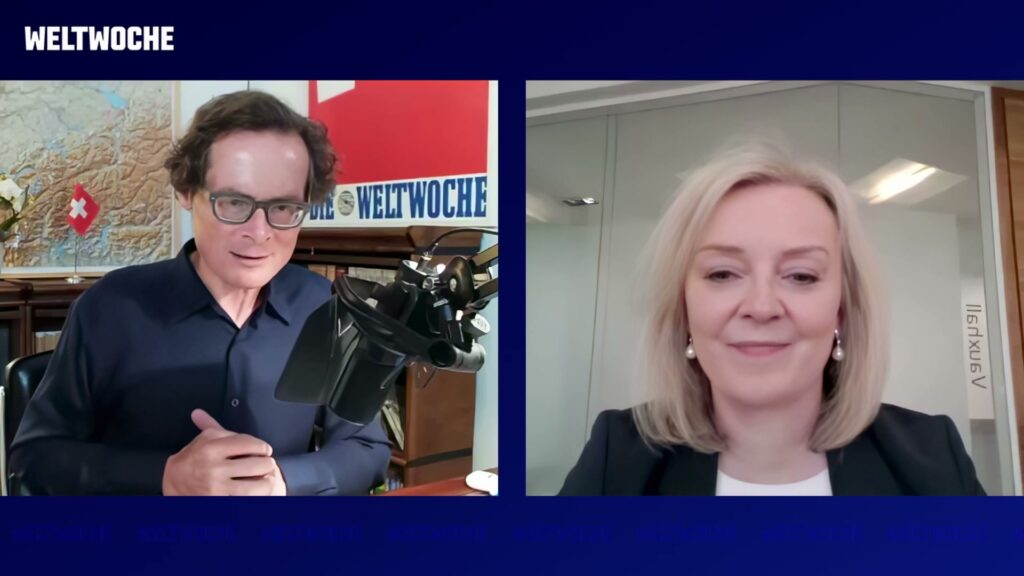
Greetings to you all. Welcome and a wonderful good day, my dear friends from up and down. I welcome you to another special episode of World Week Daily, The Other View, Unabhängig, kritisch, zuversichtlich, aufgezeichnet am Donnerstag, dem 26. Juni 2025. I'm back from Los Angeles and now have the great honor to speak to you. with a very experienced British politician who has been active in various ministerial posts since 2016, last as Prime Minister, Foreign Minister and other functions. And I will now switch to English so that she can understand me. So a warm welcome to you, former Prime Minister Elizabeth, called Liz Truss. It's great to have you here on our program. In a tight schedule, you're a very busy person. Thanks a lot for the time you're saving for us. Good to be on the show. Great, thanks. Well, let's just start with the most obvious question. You have been Prime Minister of Great Britain. You have been Foreign Secretary of Great Britain. What is actually in this current crazy state of the world? What's your greatest concern? what do you consider the greatest, the gravest problem of the world right now? I think the greatest threat to the world is the rise of China. And I think the issue that we face in the West is that Western civilization is being attacked from the inside. So what we have is we have leftist ideology, whether that's extreme environmentalism, whether it's Keynesian or even Marxist economics. whether it's transgender ideology or whether it's Islamism, all of those ideas which are essentially anti-Western civilization, I believe are undermining parts of our society. I believe they've infiltrated our institutions. And I think that's the big fight we have. And unless we win win that fight, we won't be able to take on the rise of China, which is... an authoritarian regime where people do not live freely. In what sense is China a threat? I mean, we see that many countries in Europe, Switzerland included, they have important trade relations with China. What is, in your eyes, in your view, the problem of China, the threat that China represents? What we know is that China is building up its military capability. We know in some areas of technology it's now outstripping the West. It's done that not through fair means, but by undermining the global trading system through things like intellectual property theft, subsidising industries, state-owned enterprises. And what I believe that China and its supporters are seeking to do is impose that kind of authoritarian approach beyond China. And that's what I worry about. I worry about the development of increased surveillance. I worry about things like central bank digital currencies. I worry about the approach of totalitarian and authoritarian regimes. And of course, China is in league with Russia. It's in league with North Korea. It's in league with Iran dominating the world rather than what we've had for the last 100 or so years. which is leadership from free Western societies. I think that's the battle we're in. I think we're in a battle for the future of the West. Where do you see the American president, Donald Trump, in this battle? You are a supporter of him. You have a positive picture of him. Where does Trump stand in this great battle? Is he a silver lining on the horizon? How do you assess his leadership? in regard of the problems you have just mentioned? Well, I hope that here's the start of the fight back of the forces of Western civilization. What we saw under Biden and what we're still seeing under the leadership of Europe is appeasement of the forces I was talking about, whether it's extreme Islam, whether it is the forces of big government, whether it is the forces of ideologies that undermine the family, like transgender ideology. We've seen those forces either being actively embraced or at the very least, appeased by the establishment in America, in Britain, in France and Germany. And Donald Trump is fighting back against that. He's fighting back against transgender ideology. He's fighting back against mass migration and the kind of human rightsification of the West. I mean, in Britain, we have a situation where foreign criminals aren't being deported because of our human rights law. And what's happened is essentially ideas that were meant to help people in our country have been weaponized against people in our country by left-wing legal activists. And I see Donald Trump as a force fighting back against that. And what I want to see is I want to see a domino effect in Europe of those types of forces, those types of political movements winning, just like the MAGA movement has won in America. And by the way. In the United States, this is not a done deal. I mean, we've just seen the Democrat primary for New York and an absolute nutter, you know, who is anti-American, anti-Western civilization be selected by the Democrat Party. So this is a live battle that is going on in all of our countries right across the West. What's the core reason of this, should we call it, decline of the West? One could even say, Those authoritarian tendencies you see are authoritarian. It's more than tendencies in countries like China. We somehow seem to adapt them by fighting free speech. You know, I've heard that in Great Britain, even if you say the wrong thing, you can end up in jail. Please correct me if I'm wrong. In Germany, we see that, that the politicians that are not part of the mainstream or people who start to criticize the government, they can get into trouble with Where does it come from, these self-destructive authoritarian tendencies in our societies? Well, it is true that people in Britain have been put in jail for what they have posted on X. So there's a woman, Lucy Connolly, who was given 31 months in prison for posting on X. And this is completely against traditional British liberties. We were the first country. to invent freedom of the press in 1695. And this is being undermined. And we're seeing the way that the AFD has been declared an extremist organization, the way that Marine Le Pen has been banned from running in the French election, that what is happening is the forces of the authoritarian left, and this is a sort of neo-Marxist movement, have stopped fighting at the ballot box. And they are now trying to find other ways to impose their will on society. through lawfare, through infiltrating the bureaucracy. And one of the big problems we've got in Britain is we have an unaccountable bureaucracy that is not actually doing what the public want. And this is essentially breaking down democracy. It used to be the case that the people elected the government and the government did what the people wanted. It's now the case that the technocracy define what needs to happen and they tell the politicians and the politicians tell the public. It's gone. completely wrong. But how did this start? Well, I think these ideologies emerged in universities, particularly in the 1960s and 1970s. They then moved into the public sector, and they have become dominant in our establishment. So this whole idea, this ludicrous idea that men can become women, that... That's been broadly accepted in elite circles in Britain in the last 10 years. I mean, absolutely extraordinary. But that is what has happened. You are a fierce critic of Russia and its president, Putin, regarding, of course, also the war in Ukraine. What do you say to those, probably also a bit Donald Trump, people who think that one should find a diplomatic solution to... solve that conflict, that one should engage in diplomacy with President Putin. What do you say to advocates of these policies? What I say is that Putin has been the aggressor in this conflict. And this has been going on for some time. The reason he invaded Ukraine is he believed he could get away with it because the West had not taken enough action previously. when he violated all kinds of red lines. And what we know about Vladimir Putin is his word cannot be trusted. We know that commitments he made are not followed through on. So I think the only way to stop Russian incursion is for Europe to spend more money on defence. It is for Europe to not become economically dependent on Russia, which is what had happened in the past, and put that economic and military pressure on Russia. I think the real danger is if the message goes out that Putin has been rewarded for... pursuing this war in Ukraine. That sends a message to aggressors around the world of you can get away with anything. And of course, President Xi in China will be looking at that and taking his own conclusion from that. President Trump seems to be saying that he has a certain understanding that the NATO Eastward expansion is a problem for Russia. Also, people from the, you could say in the broader sense, the team of Trump. tend to this kind of interpretation. Now we had the NATO summit. What would you argue with Trump when he would say, well, you know, we pushed too much NATO. That was a problem for Russia. It was an interference with their security interests. Do you think that's, yeah, do you think Trump is wrong in that? Well, I think the whole issue of Russia goes back to what happened at the end of the Cold War. and Everybody was so delighted, and I remember the Berlin Wall falling. Everyone was so delighted that finally these people had freedom, that there was no real holding the Soviet Union to account for what had happened in the preceding decades. And money and resources were given to Russia without strings being attached. and I think that is where you saw the start of the creation of what is now a kleptocracy in Russia. So the problems are very deep-seated, and there were many mistakes made in terms of the position that we are now in. I don't think countries being part of NATO should be a problem. It is a defensive block to prevent aggression. I'm a supporter of NATO. What I would say about where we are now, though, is I want to see this war end like everybody else wants to see this war end. The important point is Russia cannot be rewarded for what they've done. That is the very important point. I think Russia is seriously weakened. And people have understood that they're not the force that they once were, but they cannot be seen to win. That's what's important for me. You have been first, if I'm correct, a skeptic of Brexit, but then you changed your mind. This, of course, is a huge topic for Switzerland, the relations to the European Union. Could you say something about it? How do you see the European Union? A lot of discussions with the Swiss, and I understand. What advice would you give us in our relationship to the European Union? What's your insight there? I mean, I was never a fan of the European Union, let's be clear. But I knew that it would be a difficult... a difficult process for Britain to disentangle itself from the European Union. And also, I felt that most of Britain's problems were homegrown. Most of our problems were down to bad things happening in Britain, whether it was our terrible planning system, our oversized welfare state, our high taxes. You know, there were a lot of problems we could fix at home. I think what Brexit has done is it's now... made the British state accountable for its own failures. So previously, people always used to blame the bureaucrats in Brussels for everything that was bad about Britain. And now we're having to face up to the fact that the problem is really the bureaucrats here in London. I mean, I'm not saying the problem was also the bureaucrats in Brussels, but the problem is the system here in Britain doesn't work. So I think it has made our country more accountable. I think it's been And. a good thing. The problem is that even though we left the European Union and we voted to leave in 2016, we've still got all of the EU laws on our statute books. So we haven't become Singapore on Thames. We haven't become this freedom fighting nation that is open to crypto, open to AI, open to the world's greatest technologies. We've just become... a small version of Europe that's not actually part of it. And the problem is the entire continent is in decline. You know, Western European economies in particular, I mean, Eastern Europe is a slightly different situation. They're doing better. But if you compare us to America, America has been powering ahead. And we are living in a high regulation, high tax, high welfare museum. And we all need to break out of it. And that's not just Britain. That's France, Germany. Many of the other countries in Western Europe are in a very stagnant situation. So that's where we are. I think I've negotiated with the EU about the Northern Ireland Protocol. I know how difficult they are to deal with. Rather than trying to build a relationship and seeing a growing pie with their allies, like Switzerland or the UK, they see it as a zero sum. And I think that's a problem of the European bureaucracy. And I would love to see the European Union just disappear. I don't think it's added value to the countries of Europe. I think the publics of Europe are very frustrated with it. I think dealing with Europe is very difficult as, you know, the fact that the US have negotiated a trade deal with the UK, but they haven't been able to negotiate a trade deal with the EU tells you what you need to know. And what's your advice to Switzerland? Should we institutionally get more involved with the EU or keep a safe but friendly distance? I think your independence is a valuable thing, and it's one of your assets as a nation. And we are able to do, we did a great trade deal with Switzerland. You are a fantastic financial center. And... I would just be tough on the EU because what they're trying to do is they're trying to bully countries like Switzerland. That's what they're trying to do. And I think that their close geographical partners like the UK and Switzerland should be clubbing together to take on the EU. I mean, it's amazing. Or let's say it's very interesting. The Conservative Party was in a dominant position. After the election campaign of Boris Johnson at the time, focusing on Brexit, get Brexit done, and then somehow it seemed to fall apart. And now the Conservative Party is in real trouble. We have a new Conservative Party, or whatever you want to call it, with Nigel Farage. He's coming. What's wrong with the Conservatives and how do you... assess movements, so-called populist movements like the one of Nigel Farage, but there are others. We mentioned a few in Germany, in France, etc. Yeah, what's your take on that? What's happened in Britain is that the political landscape has completely changed, just like it has in America. People now living in small towns, in rural areas, in former industrial areas, are the conservatives. They're the people who believe in the nation state. You know, they believe in free speech. They believe in the family. And what you've got is the other side of the argument, believe in things like transgender ideology, you know, wokeism, environmentalism. And the problem for the Conservative Party is it is split because part of the Conservative Party want to keep in with the establishment. So they don't really want to take on that orthodoxy. Whereas others in the Conservative Party want to be more like Donald Trump and take on the left-wing orthodoxy, change our countries, be it back to how they were, stop mass migration, stop high energy prices, etc., etc. And the Conservative Party just hasn't made up its mind. And a lot of the fights that have been going on, including when I was prime minister, including when Boris Johnson was prime minister, including during Brexit, have not been resolved. And Nigel Farage has stepped into that gap because there is going to be at the next election a fight, as there is in every Western country, between the globalists and the nationalists. And the Conservative Party have not decided which side they're on. And that is fatal in politics. We know that the Labour Party are globalists. We know the Liberal Party are globalists. We know the Reform Party is a nationalist party. What is the Conservative Party? That is not being defined. What do you think about Nigel Farage? He recently said he could or would be the next Prime Minister of Great Britain. Is this a man? Who can be trusted? Is his party a reliable force? So I don't know Nigel Farage very well. I think a lot of the ideas he puts forward are the ideas that people in Britain want to, you know, they want change. I think there are people in the Conservative Party who are also putting ideas forward that people in Britain want to hear as well. The big problem in British politics has been politicians make promises, but they're not the people actually running the country. The country is run by the bureaucracy. And I don't know if you've seen the 1970s show Yes Minister with Sir Humphrey. Well, Britain is like that, but it was turbocharged by Tony Blair. He gave huge powers to the Bank of England, huge powers to the human rights lawyers. huge powers to the environmental activists. And what it has meant is that it's pretty difficult to do anything. So whether it is the Conservative Party that win the next election, or it is reform that wins the next election, the important point is that whoever wins has to be prepared to take on the deep state, just like Donald Trump has taken on the deep state in America, because otherwise, nothing in Britain will change. And that is the problem we face as a country. So for me, it's not about the particular individuals. It's about are we prepared to dismantle the bureaucracy that has failed Britain for, well, over 40 years? And do you think that the Conservative Party is up to this task? Or do we see what Viktor Orban called recently at the summit meeting, Die Weltwoche, organised in Vienna, we asked him, do you see a broader... downfall of Europe or of the EU? And he said, no, I see the birth of a new leadership class. We see the birth of a new mainstream. And then with this, he meant these new parties coming up. How do you see that? I mean, are parties from Nigel Farage, like these kind of parties, are they the future? Are the conservatives up to this task? Or is there a scenario where the Conservative Party could be marginalised. in Great Britain and the new force could suddenly dominate the conservative side of the spectrum. So I have no doubt that a British people want to vote for a populist nationalist party, you know, that represents the nation state, maintaining our borders, reducing immigration, getting rid of transgender ideology, all of those things. That's what people actually want to vote for. And they're incredibly frustrated that, you know, that's not being done, that illegal migrants aren't being deported, that crime isn't being dealt with, that the police have been captured by woke forces. What happened in America, of course, was Donald Trump took over the Republican Party. So he made the Republican Party that party. Whereas what's happened in other countries is a new party has emerged and replaced that party. So it's hard to tell. in Britain, what the exact situation will be in 2029, which is the next election. So either of those two things could happen. But I have no doubt that whoever is the most credible leader representing real change in Britain, a credible leader who is saying how they're going to deliver it, how they're going to take on the deep state, how they're going to challenge the establishment, that will be the leader that wins. But I think the jury is out at the moment. on who will have the most credible offering. And the thing about British politics is things change so incredibly fast. So if you look at what's happened since 2015, the Brexit referendum, the Boris victory, the Theresa May government, I mean, it has been a very crazy period, but I think it is going to get even more crazy. That's my prediction. Sometimes it has to get crazy before sanity returns. Well, I think it does because I think we are at the tail end of the Blair era. This is where all of the Blair chickens have come home to roost. And the country is not working. The economy is stagnant. Immigration is very high. Crime is rising. People are very, very frustrated that public services don't work. And the country is ready for a massive change. And it's, you can just feel it. Fascinating. You mentioned the deep state. When you were prime minister, you came up with a very brave bill. And it reminded me a bit of the big, beautiful bill of Donald Trump. And when he came up with his plan, the stock markets started to tremble. The central bank of the United States, the Federal Reserve, they started to attack Donald Trump. But he somehow could stay in the saddle. Whereas you, when you came up with this, I have to say, very brave program, in Great Britain, similar things happened, but you have been attacked then and you had to step down after a short period as prime minister. What's your memory of this episode? What would you do differently? Because I thought Trump had probably a stronger mandate than you. He was elected by the public. You had not this popular support behind you, but we're going... strongly, fiercely into a huge problem field. But I would be curious, how do you see this, what do you say, this crucial event in your premiership? I mean, what would you do differently? What's your take? What's your lesson you learned from that? Well, you are right that Donald Trump and the big, beautiful bill, it is trying to do very similar. to what I was trying to do. And they're facing the same forces of resistance, which is the central bank. I mean, I think the Federal Reserve is a big problem and the Bank of England is a big problem. But all of the people around in the financial system that rely on the central bank become part of the problem as well. And that's what happened to me. I had the Bank of England were essentially undermining what I was doing with their policies. And they were briefing against me and leaking against me. And it's very, very difficult to do that, especially as I was in a weaker position than Donald Trump is. And one of the reasons I was in a weak position was what I was talking about earlier, the Conservative Party was split. But I had a basic choice, Roger, which was, did I try and put the country on the right trajectory or did I do nothing? And doing nothing, as my successor Rishi Sunak showed. resulted in economic stagnation and the Conservative Party getting the worst results since 1834. So I thought it was better to try and take on the forces of the economic establishment to try and do the right thing for my country. Now, they sabotaged me, but what I learned is I learned how powerful they are, how underhand they are, and that in order to really change Britain, they will have to be dismantled and taken on. So it's given me a massive lesson about the power of the British steep state and what now needs to be done to take it on. So we need to repeal all the laws Tony Blair put in place, which gave all those people more power. We need to appoint the senior bureaucrats in the British system on... the basis of people who are prepared to carry out the policies, not the permanent bureaucracy. So it's made me realise how big the change is in Britain and also why it was none of my predecessors did anything, because it was fatal. Now I now understand why it was, because when you're a minister at a more junior level in the government, you're looking at your superiors and you're thinking, why on earth don't they do these really obvious things? Why aren't they getting on fracking so that we can reduce our energy prices? Why aren't they cutting corporation tracks to attract more businesses? And what you realize is they simply don't have the levers to be able to do that. And that is a massive democratic problem in our country. And how did you cope with that personally? I mean, politics is a battle zone of extreme intensity. I mean, you have seen the highs and lows in your career. You had all the... posts in the government that then suddenly from one day and the other you're in the middle of this earthquake against you how did you manage how did you navigate through these extreme situations i mean i'm i'm very driven by what is actually going to make our country great again you know that's what i'm a patriot that's my motivation in politics so that's what i thought about all the time and You know, when I had to step down, I did it because essentially the Bank of England were playing a game of chicken with the British economy and I couldn't stand there and watch. watch things collapse because they were undermining me. But that's what I'm in politics for. And it's why I continue. I wrote the book, 10 Years to Save the West. I've continued to make the case for defending Western civilization against these leftist forces that have unfortunately infiltrated much of our bureaucracy. And that's what motivates me. And that's what I think about. You know, of course, it's tough being in politics. But if I don't do it, who else is going to do it? If people aren't prepared to step up, are they really prepared to let our civilization crumble and for China to take over? That's not what I want. My final point in our conversation, thanks already, is this. Your next plans, you're... You could say you're dedicated now to create a new social network, I have read, I mean, which is focused on enabling free speech and free speech, free expression of thoughts, etc. What are your plans there? What is ahead? What is coming? What are your projects that you're working on now specifically? Well, so I'm working on a free speech media network so that we can deal with the... problems of the mainstream media in Europe. We're not hearing the truth about what's happening. One example here in Britain is these Pakistani grooming gangs that have been targeting young girls and there's been a huge cover-up and there's very little coverage in the mainstream media. So I'm determined to take on the mainstream media and actually tell the truth about what's happening. I'm also very focused on how do conservatives, people who support this agenda, work together. The left have a very powerful network. You know, whether it's Davos, whether it's the Soros network, they coordinate. And a lot of these policies we've been talking about or movements we've been talking about, you know, the pro-Hamas campaigns on student campuses are coordinated by the left. And what I think is conservatives who believe in the nation state, who believe in the family, who believe in low taxes, who believe in free speech. We need to work together to take these people on. So that's what I'm focused on. Former Prime Minister, Ms. Truss, thank you very much for this conversation. And we wish you all the best and a lot of energy. The fight goes on and it's always interesting to challenge the mainstream. The fight goes on. For free speech. Thanks a lot for your time. All the best to Great Britain. Thank you. Bye-bye. Bye.


 Meine Favoriten
 Abmelden
 Registrieren
 Weltwoche Deutschland


 Anhören ( 32 min )