

 Meine Favoriten
 Abmelden
 Weltwoche Deutschland


 Anhören ( 7 min )
 When a film is declared “the movie of the year” months before ballots are cast, caution is justified. Early consensus can become self-fulfilling; praise hardens into inevitability. Yet One Battle After Another is not the sort of film that coasts on politeness or prestige branding. It is loud, ideologically charged, structurally sprawling, emotionally volatile, and visually assertive. If it has become an awards frontrunner, it is not because it plays safe. It is because it dares to be unruly. The question is not whether the film is ambitious. It is. The question is whether that ambition coheres, or whether the film’s appetite for escalation overwhelms its emotional core.
IMAGO/Landmark Media
The story is operatic from the start. “Ghetto” Pat Calhoun, played by Leonardo DiCaprio and Perfidia Beverly Hills, portrayed by Teyana Taylor, are lovers inside a far-left revolutionary cell called the French 75. Their romance unfolds amid prison breaks, bomb plots, humiliations, betrayals, and ideological fervor. Perfidia murders, compromises, survives. Pat goes underground. Their daughter grows up inside myth. Sixteen years later, the revolution has curdled into paranoia, secrecy, and generational confusion. White supremacist societies lurk in the background; sanctuary cities operate like fragile enclaves; militias and secret clubs manipulate events from the shadows. On paper, it sounds excessive. On screen, that excess becomes the film’s defining trait.
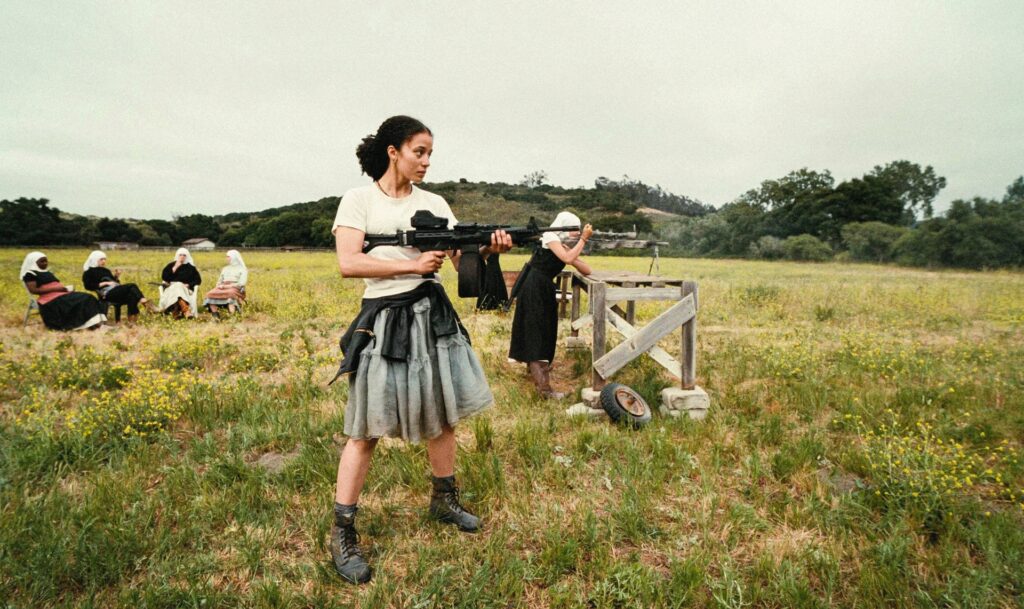
Visually, the film commits to scale. Wide desert landscapes contrast with claustrophobic interiors. Public institutions are shot in harsh, overexposed light, sterile, surveilled, unforgiving. Domestic scenes are warmer but unstable, shadows creeping into corners. The imagery reinforces the film’s central idea: politics is never abstract; it invades the private. Even the convent of revolutionary nuns, a concept that could easily tip into parody, is filmed with straight-faced seriousness. Stone corridors, dim candlelight, quiet confessionals repurposed as ideological classrooms. The production design grounds absurdity in texture.
The camera rarely rests. Tracking shots follow characters through corridors, across rooftops, into confrontations. Movement dominates. The rhythm of the editing mirrors the title: one battle after another. There is little pause, little relief. The film insists on momentum, and that insistence generates both excitement and fatigue. It wants you unsettled.
Performance anchors the spectacle. Leonardo DiCaprio playing Bob, the older version of Pat, embodies exhaustion. He is not a romantic revolutionary anymore; he is a paranoid stoner living off the grid, clinging to a story he once believed in. His physicality communicates decline: slouched shoulders, distracted eyes, speech that drifts between defiance and regret. The performance grounds the film whenever it threatens to spiral into caricature.
Perfidia is more difficult and more interesting. She is not redeemed. She is not simplified. She abandons her child for ideology. She betrays her comrades under pressure. She survives. The actress avoids sanctifying her. Instead, she plays conviction as something close to addiction, a need to remain pure in belief even when that purity destroys intimacy. The result is unsettling rather than heroic.
Lockjaw (Sean Penn), the security officer turned colonel, could easily have become a cartoon of authoritarian menace. Instead, he is chilling precisely because he remains controlled. His obsession with Perfidia, his racist affiliations, his eventual desire to eliminate his own daughter to hide scandal, these are monstrous impulses. But the performance never rants. It stays cold. That restraint makes him more disturbing.
The ensemble supports this triangle effectively. Even secondary characters, bounty hunters, secret society members, militia leaders are played with enough conviction that the film’s exaggerated world does not collapse into satire. The cast treats the material seriously, and that seriousness is crucial. Without it, the film would feel like parody.
Still, tonal instability remains its central risk.
The film oscillates between political thriller, dark comedy, melodrama, and generational tragedy. A DNA test conducted at gunpoint. A white supremacist society with a festive name. A revolutionary countersign determining life or death. These are heightened elements. Sometimes they feel electric. Sometimes they feel forced. The screenplay enjoys escalation; it pushes conflict to the edge of plausibility.
Yet there is an argument that plausibility is not the point. The film operates like political opera. Emotions are amplified. Betrayals are theatrical. Violence is symbolic as much as literal. In that register, exaggeration becomes stylistic choice rather than mistake.
Where the film finds real power is in its generational dimension.
Willa grows up believing her mother was a martyr. She discovers instead a history of compromise and betrayal. The revolution she inherited is not pure. It is stained. Her anger does not dissolve; it mutates. When she demands the revolutionary countersign from her own father at gunpoint, the scene crystallizes the film’s thesis: extremism reproduces itself. Children inherit not clarity but conflict.
The domestic scenes between Bob and Willa are the film’s quiet center. Their arguments feel contemporary and painfully human, a daughter frustrated by her father’s decline, a father desperate to preserve meaning in a collapsing narrative. In these moments, the camera slows. Dialogue breathes. The film feels less like spectacle and more like tragedy.
It is here that I wished the film lingered longer.
Because when it does pause, it resonates. When it accelerates, it impresses. There is a difference. Impression can dazzle; resonance stays.
The final act returns to operatic scale. Lockjaw’s near-assassination, his grotesque survival, his ultimate extermination by the very extremist club he sought to serve, these are bold, symbolic gestures. Extremism consumes its own. Loyalty is rewarded with annihilation. The message is clear without being sermonized.
The ending offers no real resolution. Bob gives Willa her mother’s letter. She heads to a protest. The cycle continues. There is no triumph, only continuation. The film closes not with catharsis but with endurance.
Culturally, this explains much of the film’s acclaim. It captures the exhaustion of permanent conflict. Politics today feels recursive, outrage feeding outrage, crisis layered upon crisis. The film mirrors that rhythm. It does not offer solutions. It dramatizes the cycle.
That relevance is powerful. It also partly explains why critics have responded so strongly. The film feels alive to its moment. It addresses ideological extremity without flattening it into easy moral binaries. It distrusts purity on both sides. That symmetry feels bold in a polarized era.
But ambition alone does not guarantee greatness.
At times, the film’s determination to be expansive diffuses its emotional impact. Scenes that might devastate are followed too quickly by the next escalation. The screenplay occasionally underlines its themes too clearly, as if worried the audience might miss the point. The film wants to be tragic opera and political satire simultaneously. When it balances the two, it is exhilarating. When it does not, it feels strained.
So is it “the movie of the year”?
It is one of the most ambitious films of the year. It is one of the most culturally alert. It contains performances that will be remembered and images that linger, a scarred face emerging from wreckage, a daughter holding a gun with trembling certainty, a father convincing her to lower it.
But I hesitate to call it a masterpiece.
A masterpiece transforms chaos into inevitability. This film sometimes feels like chaos tightly managed rather than transcended. Its structure holds, but under pressure. Its escalation is thrilling, but not always profound. It earns admiration more consistently than awe.
And yet, in a cinematic landscape often dominated by safe spectacle and franchise repetition, there is something bracing about its refusal to shrink. It risks imbalance. It risks absurdity. It risks overreach. That alone distinguishes it.
What remains with me are not the explosions or conspiracies but the quieter exchanges, the look of doubt on Willa’s face, Bob’s exhausted tenderness, the realization that ideology, once inherited, can be harder to escape than to embrace.
One battle after another: the title is not celebratory. It is diagnostic. The film suggests that modern political life is not defined by resolution but by accumulation. Conflict does not end; it compounds.
For that insight, and for the audacity with which it stages it, the film deserves serious consideration. It may not be flawless. It may not be transcendent. But it is alive, restless, and unafraid of excess.
In a year crowded with polished restraint, that may be enough to set it apart.
About the Author:
David Mamet is a Pulitzer Prize–winning playwright, screenwriter, and essayist. His most recent book is The Disenlightenment: Politics, Horror, and Entertainment. He writes frequently about culture, politics, and the language of power.